• Skip to primary navigation
  • Skip to main content
  • Skip to primary sidebar
Kinney Brothers Publishing Logo

Kinney Brothers Publishing

ESL Teaching & Publishing

  • Kinney Brothers Publishing
  • KBP Shop
  • Games+
  • About Us
  • Contact
  • Press

Search Results for: history in publishing

Fun Facts About English #35 – Words That Changed Meaning

12/13/2019 by admin

Kinney Brothers Publishing Fun Facts About English 35

The Old English word awe (ege) referred to fear, terror, or dread. Two derivative words, awful and awesome, both meant reverential wonder but evolved in completely opposite directions. Awful later took on a strictly negative connotation and, sometime in the mid-1900s, awesome came to mean extremely good.

Below are twelve more common words where meanings have evolved or changed over the centuries.

English Timeline

Audition

The Latin words audire and auditio(n) mean the ‘power of hearing or listening.’ In the 16th century, an audition was a medical term for unblocking a person’s hearing. In the 19th century, trying out for a play was called a ‘hearing’ where a playwright ‘listened’ to a person recite something. Writers began using audition as a fancier term for a ‘hearing’ and the word stuck.

Cheater

In the Middle Ages, upon the death of an owner of land without legal heirs, ownership lapsed to the Crown. This was known as the Crown’s right of escheats, from the Old French eschete and the Latin excidere, meaning to ‘fall away. ‘ The keepers of a king’s escheats were known as cheaters. Thieves swindling ignorant people with false Royal Seals led to a mistrust of the king’s cheaters and hence the current sense and use of the word.

Cute

Cute is a shortened version of the word acute. It originally meant sharp or quick witted, and was often written as ‘cute — with the apostrophe indicating the missing a. In the United States during the 1830s, cute came to mean attractive, pretty, or charming. Vestiges of its original meaning can still be heard in phrases like “Don’t get cute with me!” referring to a person trying to be smart or clever.

Egregious

The mid-16th century Latin word egregius meant “illustrious, select,” or “standing out (ex-) from the flock (greg-).” In short, egregious described something remarkably good! Possibly due to ironic use of the original meaning, the word has since taken the opposite tract with contemporary synonyms being “shocking, appalling, horrific, and terrible.”

Fathom

Fathom is defined as 1) a measure of 6 feet and used in determining the depth of water and 2) to consider after much thought. The first definition was originally the span of a man’s outstretched arms and varied between 5-5 1⁄2 feet. To measure the depth of shallow waters, boatmen used a plumbed sounding line with fathom points. To fathom something figuratively, as in the second definition, means to ‘plumb the depths’ of an idea, where the result is sometimes unfathomable.

Fizzle

In the 16th century,  fysel meant to “quietly break wind, or fart.” The contemporary word fizzle means 1) to make a hissing or sputtering sound, as in a gas forced out a narrow aperture and 2) to fail or die out, especially after a promising start. The second definition dates back to at least 1847 in American college slang as “a failure in an examination or a mumbled and stifled performance.” 

Literally

Until recently, literally meant “in a literal manner or sense; exactly.” Literally is now often used for emphasis or to express strong feeling while not being completely true, e.g., “I was literally blown away by the movie.” Similarly used words would be real-ly, actual-ly, serious-ly, and total-ly. The egregious ‘misuse’ of this word is so totally widespread that the Oxford English Dictionary has literally added this as a definition. Seriously.

Meat

The Old English word mete referred to all food, even animal feed. When English moved into its Middle English era, it came to mean food from animal flesh. Meat in the figurative sense, as in “the meat of the matter,” or “a meaty novel,” appeared around the turn of the 20th century.

Myriad

In its Ancient Greece origins, the Late Latin word myriad meant 10,000. In Aegean numerals used during the Bronze Age, it was represented by a circle with five dashes. Today, myriad is a very great or uncountable number of things, as in “The myriad lights of the city.”

Naughty

Naught is defined as “zero, or nothing,” as in “All for naught.” In the 1300s, if someone called you naught-y, they were accusing you of being poor or needy. By the 1400s, naughty changed from “nothing” to “being bad or wicked.” Naughty could refer to a person who was behaving sexually provocative or, when applied to children, mischievous or disobedient. After six centuries, our current use of the word still refers to this sometimes stern, but more often playful childhood admonishment.

Spinster

During the late Middle Ages, a spinster was, by definition, a person who spun yarn or thread. This low-paying occupation was held almost wholly by unmarried women. Spinsters who married were in a social position to find higher status work and better pay. In legal documents where one’s occupation was used as identification (like Smith, Baker, Cook, and Hunter), spinster came to denote an unmarried woman. It also held the pejorative connotation of a woman’s undesirability in marriage, e.g., old age.

You might also be interested in proverbs that are often mistaken! Learn the history of the words rooster and jaywalker. Did you know everyday and every day have different meanings? Learn all about these topics and more on the Kinney Brothers Publishing blog!

See the previous or next Fun Facts About English

Donald's English Classroom

Check out the 68 Stories For Young Readers lesson packs from Kinney Brothers Publishing! The colorful series is also available as paperless lesson packs for the 21st-century classroom! Each lesson pack includes full lessons, audio, dialogues, and answer keys!

Filed Under: Fun Facts About English Tagged With: Donald's English Classroom, english language, etymology, historical linguistics, kinney brothers publishing, language development, language evolution, language history, lexical evolution, semantic change, Word meanings, word origins

Using Maps in Class

12/11/2019 by admin

When I began learning Japanese in the early 80s, it was imperative that I learn how to ask for directions from the get-go – especially in Tokyo. Not only did I have to deal with my lacking sense of direction, I was also functionally illiterate as I didn’t know any Japanese when I first arrived. A guide book and a paper train map were always in my bag. I also remember the huge city map on the kitchen wall in the foreigner’s house where I lived; an invaluable reference for fresh-off-the-boat travelers like me. To whatever train station I might be going, I regularly stopped at the local police box to ask directions – even if I already knew where I was going. Why? It was excellent language practice and I milked it.

Looking back, I was lucky. I was in the real world, immersed in a new language, and learning daily. Because we teach in a box, we have to find inventive ways to bring meaningful, real-world language into the classroom. Maps offer a visual opportunity for building language skills.

In my own book publications, I created maps and activities that are included in the Phonics & Spelling series, Q&A worksheets, and referenced for nearly every story in the Stories For Young Readers textbooks. I wanted my kids to know where they are in the world, learn about someplace new, and not be afraid to ask for directions or offer help to someone in need.

Stories For Young Readers Lesson Packs  Kinney Brothers Publishing

Consider all the language used when dealing with maps:

  • geographical vocabulary – rivers, lakes, mountains
  • community places, cities, capitals, countries
  • prepositions of place – in, on, in front of, behind
  • directionals – north, south, right, left, forward, back, around
  • ordinal numbers
  • grammar tenses – past, present, and future
  • map vocabulary – legends, icons, scales
Donald's English Classroom Community Places

Starting early…

As my kids get older and catch on to the fact that I don’t really swim from the U.S. to Japan every day, we start learning community places, easy country names, and playing games with flags. Flags are already familiar to many sports-minded kids and there’s no reason to be ignorant about your favorite team’s home turf. In preparation for the Jidou Eiken tests, community place names and geographic vocabulary are a regular part of my flashcard activities. Keep in mind, these kinds of exercises can be just as informative and entertaining in your adult ESL classes!

Worksheets Kinney Brothers Publishing

When students begin moving about in their community and become aware that some people come from other places, like me, we start working with maps. Map activities pull together a variety of language skills — language you’ve probably been teaching your kids since they were little! It begins with prepositions of place and sight words like at, in, on, next to, and in front of. Interrogatives like where, what, and how come early on when asking the most rudimentary questions.

Once students develop informational reading skills, we look at town maps and tackle exercises in asking for and giving directions. We start with simple commands like Turn right! Turn left! and Go straight! Similar to community flashcard exercises in the past, students express where they are or want to go on the maps, e.g., I want to go to the station, or I’m at the library. Especially with large classes, big wall maps are essential for leading students through these types of activities.

Map making…

I went out in search of maps for my classroom many times and in many places around Tokyo. I could never find what I was looking for! Available maps were the wrong language, too expensive, too complicated, too big, too small, and so on. Yes, I’m picky, and I’m not going to have something in my classroom simply for decoration. What I wanted were easy-to-read and colorful wall maps appropriate for upper-elementary ESL kids in English. Simple to find, right? Nope.

Donald's English Classroom Wall Maps 2

So, I started creating my own. Because I don’t have a poster-size printer, I resized digital images and created wall maps out of regular sheets of paper. The students and I glued them together as a class activity, and viola! I have wall maps of each continent, a town map for practicing directions, and a U.S. map so I can talk about where I came from. Each map is dedicated to the class that helped put it together with a picture of the students and the date.

Doald's English Classroom Map Instructions

I also wanted the maps to be an interactive resource in my lesson plans. So, along with the wall maps, I created charts, worksheets, plus blank and numbered maps for classroom activities and handouts for students’ interactive notebooks. These are items not normally sold with maps you buy at a bookstore. Importantly, all the student materials are congruent with the wall maps and I’m not hobbling together different resources to create a series of lessons.

I’m pleased to say, these maps are now available in my online store. Click on the images to learn more. I hope you find these maps useful in your own classes.

Map Worksheets Kinney Brothers Publishing

Playing with maps…

Here are some map activities I’ve found particularly useful in class. If you have some activities you especially enjoy, help a teacher out and let us know in the comments below!

  • Create your own town! With a blank town map and a list of community places, allow students to create their own towns! Then have students ask and give directions based on their created maps. Let students visit each other’s town or vote on their favorite town!
  • Give students a numbered or blank map. Beginning with a labeled place, like a station, dictate directions and have students label the place of arrival on their own maps. This works well as an assessment of lessons taught.
  • Ask students to imagine a country they’d like to travel to for vacation. Create an outline of topics you would like them to research: weather, geography, food, history, etc. This is great grammar practice for future conditionals. With the online tools available for research, the possibilities are endless!
Historical maps Kinney Brothers Publishing
  • For practice with past tense, display a historical map next to a current map. This activity gets your students really scanning a map closely to discover the differences.
  • Teachers who teach from their home country are more likely to have students from a variety of places. A map can be a wonderful springboard for enjoyable and informative language practice. Pin the countries where students are from or have traveled to on a world map. Students love to talk about what they know best: their home country and all its unique cultural differences!

Finally, if you’re teaching about the United States and want your students to know their state names, capitals, and regions, check out my post on U.S.A. Maps and download a free map puzzle!

free map puzzle

I hope this post encourages you to consider using maps more often in your ESL lessons. I’ll finish with a favorite quote:

I was completely drawn to other lands. I discovered with time that it’s a thirst for other people, for otherness, for something fascinating and mysterious. Robert Lepage

As always, best of luck in your classes!
Donald Kinney

Filed Under: Kinney Brothers Publishing Tagged With: Classroom Activities, cultural diversity, directions, Donald's English Classroom, English as a Second Language, esl, geography, interactive materials, kinney brothers publishing, language learning, maps, prepositions, teaching resources, vocabulary

Fun Facts About English #29 – Ambigrams

11/01/2019 by admin

Kinney Brothers Publishing Fun Facts About English 29

An ambigram is a word, art form, or other symbolic representation whose elements retain meaning when viewed or interpreted from a different direction, perspective, or orientation. An ambigram is not to be confused with a palindrome which is a word, phrase, or sentence that can be read the same backward or forward, such as the word ‘noon’, or the phrase, ‘Madam, in Eden, I’m Adam.‘ Ambigrams are a favorite among the creative talents of tattoo, graffiti, and logo artists, and they go very far back in history.

ambigrams

A mirror-image ambigram is a design that can be read when reflected in a mirror, usually as the same word or phrase both ways. Ambigrams that form different words when viewed in the mirror are also known as glass door ambigrams because they can be printed on a glass door to be read differently when entering or exiting.

mirror-image ambigrams

Although the term was recently coined by the American scholar of cognitive science, Douglas Hofstadter, the existence of ambigrams has been attested since at least the first millennium, where the first sator square palindrome was found in the ruins of the ancient Roman city of Pompeii (79 AD).

Ambigrams rose in recent popularity as a result of author Dan Brown’s bestseller, Angels & Demons, and the amibigram used on the book’s cover. The DVD release also contained a bonus chapter called “This is an Ambigram.”

Although the words spelled by most ambigrams are relatively short in length, one DVD cover for the movie, The Princess Bride, featured a rotational ambigram out of the words “Princess Bride” that could be viewed right side up or upside down.

Looking for more fun with words? Check out these posts about pangrams, palindromes, portmanteaux, and mondegreens! You might also be interested in reading more about the sator square and the earliest crossword puzzles!

See the previous or next Fun Facts About English

Donald's English Classroom

A Telling Story Productions is a Youtube audio collection of classic fairytales, folktales, and short stories. Audio stories are great for long trips, storytime, or a chance to revisit your favorite childhood stories!

Filed Under: Fun Facts About English Tagged With: ambigram, ambigrams, Angels & Demons, Donald's English Classroom, Douglas Hofstadter, fun facts about english, glass door ambigram, kinney brothers publishing, mirror image, palindrome, symbolic representation, The Princess Bride, word art

Fun Facts About English #24 – Blatteroon

09/27/2019 by admin

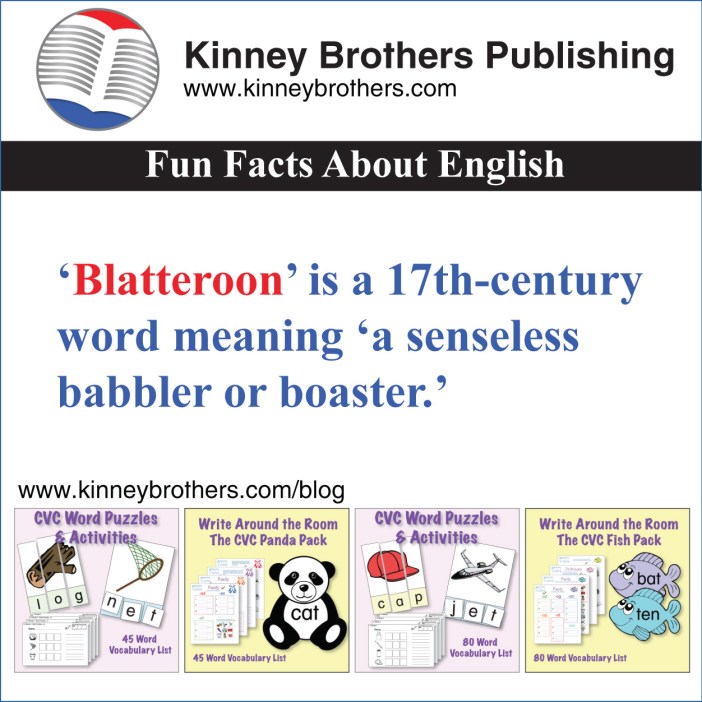
Kinney Brothers Publishing Blatteroon

The word blatteroon is from Latin blatero + -onis. In 1887, James Murray, primary editor of the first edition of the Oxford English Dictionary (OED), included blatteroon among his entries, having drawn it from Thomas Blount’s Glossographia of 1656. Its entry into the OED sparked a minor revival of the word where it otherwise would have faded into history.

Though blatteroon is considered obsolete, it exemplifies a type of loathsome behavior that is readily recognizable throughout history. We have no shortage of contemporary words to describe such personalities, including blowhard, big mouth, loudmouth, windbag, gasbag, and grandstander.

Originating in Midwestern American slang, bloviate is another word that has had a renaissance in past decades. Meaning “to indulge in ‘high falutin’,” the etymology suggests that bloviate is a “compound of blow, in the sense of “to boast” with a mock-Latin ending, as in the word deviate. Bloviate is further defined as “a kind of baby talk, a puerile and wind-blown gibberish. In content, it is a vacuum.”

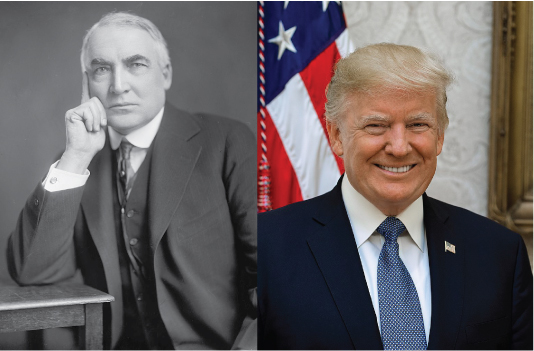
Bloviation and its style of empty political speech were used to describe US President Warren G. Harding (1921-1923) and his “art of speaking for as long as the occasion warrants, and saying nothing.” His opponent, William Gibbs McAdoo, described Mr. Harding’s oratory skills as “an army of pompous phrases moving over the landscape in search of an idea.” e.e. cummings eulogized the former president as “The only man, woman, or child who wrote a simple declarative sentence with seven grammatical errors.”

It seems that history never fails to repeat itself.

You might also be interested in learning about Old English words that are worth bringing back! Check out this post on the naughty language of expletive infixations (NSFW), or the surprising history of the verb friend!

See the previous or next Fun Facts About English

Donald's English Classroom

When it comes to teaching your kids to read and understand the world around them, it’s vital you have quality learning materials. Visit Donald’s English Classroom for downloadable English language materials you can start using today.

Filed Under: Fun Facts About English Tagged With: big mouth, blatteroon, bloviate, blowhard, contemporary language, Donald's English Classroom, e.e. cummings, etymology, fun facts about english, gasbag, grandstander, kinney brothers publishing, language history, linguistic evolution, loudmouth, obsolete words, Oxford English Dictionary, political speech, Warren G. Harding, windbag

Fun Facts About English #23 – Ampersand

09/20/2019 by admin

Fun Facts About English 23 Kinney Brothers Publishing

Maybe it would be better to say, “the & glyph was per se the 27th ‘character’ included with the alphabet.”

variations on the ampersand

In Latin, the ampersand represents a cursive combination of the two letters E and T and is pronounced et, or and in English. Around the time when Old English was shedding its runic characters and adopting the Latin alphabet, the & ligature arrived as part of the orthographic package, and to this day continues to be used to represent the word and.

19th Century ABC poster
Early 19th-century alphabet chart.

Why is called an ampersand?

The ampersand was included in schoolbooks as the 27th letter of the English alphabet until the mid 19th century. It was understood not as a vowel or consonant, but as a useful symbol, added to the hind end of the alphabet, and simply known as and. Today, when we recite the ABCs, we often say “X, Y, and Z.” Two centuries ago, children’s chants included and (&) as the last letter. To say “X, Y, Z, and and” was a bit awkward, so the Latin phrase per se – meaning “by or in itself “- was inserted. In recitations, it sounded like this: X, Y, Z, and per se and (&). Eventually, and-per-se-and slurred into ampersand, a mondegreen that we use today.

By the late 1800s, the word ampersand also became a slang term for “rear end, posterior, or the buttocks.” Over time, the & glyph was de-classified within the alphabet, its usage decreased, and today is often frowned upon when used in modern writing.

If you enjoyed this post, you might also be interested in the awesome history of dude or the origins of paddywhack from the song, “This Old Man!” Check out why the word rooster is a preferred euphemism in the United States!

See the previous or next Fun Facts About English

Donald's English Classroom

Visit Donald’s English Classroom where you’ll find a host of downloadable ESL textbooks, flashcards, charts, and games for your youngest English language learners.

Filed Under: Fun Facts About English Tagged With: alphabet, ampersand, character, Donald's English Classroom, etymology, evolution, fun facts about english, history, kinney brothers publishing, language, Latin, ligature, symbol, typography

Fun Facts About English #22 – Chess

09/13/2019 by admin

Fun Facts About English 22 Kinney Brothers Publishing


“Sheikh” (شيخ‎) is the Arabic word for a monarch. Players would announce “Sheikh” when the king was in check. “Māt” (مات‎) is an Arabic adjective for “dead,” “helpless,” or “defeated.” So the king is in mate when he is ambushed, at a loss, or abandoned to his fate.

The history of chess goes back almost 15 centuries. The game originated in northern India in the 6th century AD and spread to Persia. When the Arabs conquered Persia, chess was taken up by the Muslim world and subsequently, through the Moorish conquest of Spain, spread to Southern Europe.

Buddhist pilgrims, Silk Road traders, and others carried it to the Far East where it was transformed into a game often played on the intersection of the lines of the board rather than within the squares. Chinese chess and the Japanese game, Shogi, are the most important of the Eastern chess variants. However, it was the changes made in medieval Europe that led to the Western game known as Chess.

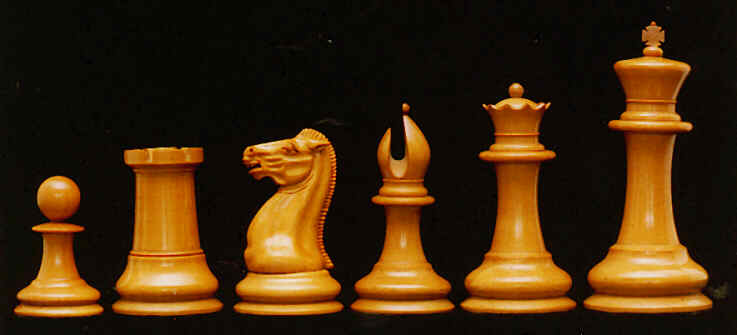
One of the most radical changes of all was the emergence of the queen as chess’ most powerful player during the 15th and 16th centuries. The shift was far from random. Instead, it reflected the previously unheard-of rise of empowered female monarchs. This form of chess got such names as “Queen’s Chess” or “Mad Queen Chess” (Italian alla rabiosa = “with the madwoman”). Checkmate became easier and games could now be won in fewer moves. These new rules quickly spread throughout Western Europe and in Spain, reflecting the modern game we know today.

You might also be interested in universal language and the world-wide adoption of pizza, coffee, and urban transportation! Click here to learn more about how science changed our world and language and familiar idioms coined by famous authors!

See the previous or next Fun Facts About English

Donald's English Classroom

Task Cards are great for centers and allow students to work independently. Check out these activities and more in Donald’s English Classroom!

Filed Under: Fun Facts About English Tagged With: chess, cultural exchange, Donald's English Classroom, Europe, female monarchs, fun facts about english, game evolution, history, India, kinney brothers publishing, medieval, Muslim world, origins, Persia, queen, Silk Road

  • « Go to Previous Page
  • Page 1
  • Interim pages omitted …
  • Page 5
  • Page 6
  • Page 7
  • Page 8
  • Page 9
  • Page 10
  • Go to Next Page »

Primary Sidebar

Search

New from Susan Good!

Balancing Remote Work and Toddler Care

Kinney Brothers Publishing

Kinney Brothers Publishing Catalogue

Donald’s English Classroom

Donald's English Classroom Catalog

Click to see full listings!

Jooble Ad ESL Tutor Jobs

Weekly Fun Facts About English!

Fun Facts About English

Now in Japan!

Independent Publishers International

Copyright © 2026 · Genesis Sample on Genesis Framework · WordPress · Log in


Loading Comments...