• Skip to primary navigation
  • Skip to main content
  • Skip to primary sidebar
Kinney Brothers Publishing Logo

Kinney Brothers Publishing

ESL Teaching & Publishing

  • Kinney Brothers Publishing
  • KBP Shop
  • Games+
  • About Us
  • Contact
  • Press

Search Results for: history in publishing

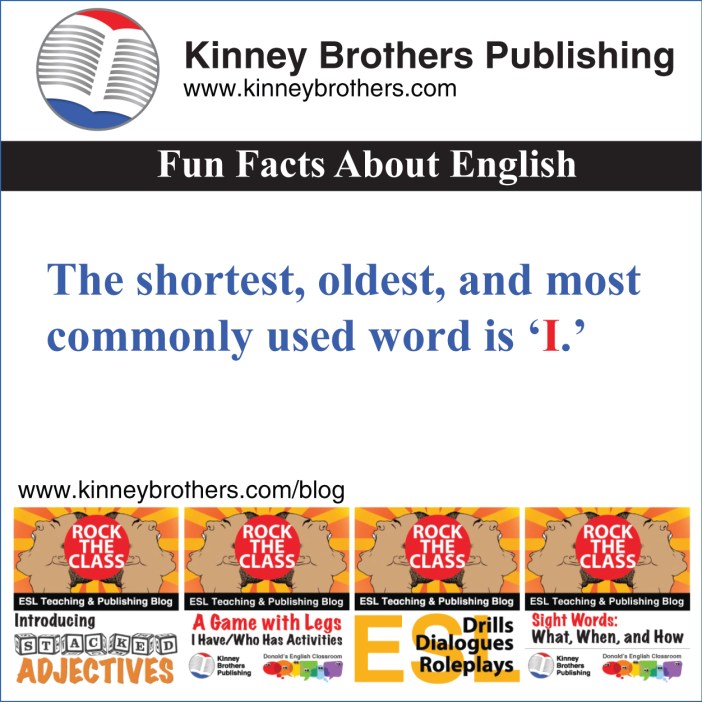
Fun Facts About English #1 – The Oldest Words

04/29/2019 by admin

Fun Facts About English 1 Kinney Brothers Publishing

Some of the oldest words in English have been identified. Reading University researchers claim I, we, two, and three are among the most ancient, dating back tens of thousands of years. What the researchers found was that the frequency with which a word is used relates to how slowly it changes through time, so that the most common words tend to be the oldest ones.

John Ayto’s Dictionary of Word Origins states, “Essentially all the Indo-European languages share the same first-person singular pronoun, although naturally, it has diverged in form over the millennia.” (French – je, Italian – io, Russian – ja, Greek – ego). The prehistoric German pronoun – eka became German – ich, Dutch – ik, Swedish – jag, Danish/Norwegian – jeg, and English – I.

Besides being one of the oldest words, there are two more curious facts about I. First, it is the only English pronoun that is always capitalized, unlike me, you, or we. Second, English is the only language that always capitalizes I as a pronoun. History gives us clues as to why this came to be.

During the adoption of the Latin script, lower-case letters were in development and gradually came into fuller inclusion by the 8th century. I had many spellings as it evolved from Old English into Middle and early Modern English. The Old English pronoun was ic or ih, with neither being capitalized. Around 1250, I was used in the northern and midland dialects of England and extended to the south of England in the 1700s. By the time Chaucer wrote The Canterbury Tales in the late 1300s, it was common to mix upper and lower-case letters within a single word and sentence. Capitals were used to add emphasis or to indicate that a letter standing alone was intentional. As a personal pronoun, I was written slightly taller than its lowercase equivalent. As the orthography developed, the lower case i, like the lower-case j, acquired an extra jot or tittle for differentiation among other letters. Additionally, the letter I was used in Roman numerals for the number one, with J operating as a “swash” indicating the conclusion of a number, e.g., xxiij.

medieval text

As printed texts spread across Europe, different languages developed different conventions when printing. There is a belief that Germans, for example, capitalize the formal you out of respect and never capitalize the less-presuming I in deference to the reader. When comparing European texts, English, with its always-capitalized I, might appear to be more writer-centric. However, with that logic, because the Germans also capitalize their nouns, it could be said that they hold people, places, and things with more reverence than English speakers. These “ideas” are more reactionary in tone and cultural hubris rather than representing historical facts. It is more likely the use of capitals is simply part of the writing conventions of a given language, developed over time, and directly relates to their ease in being read. Nonetheless, as we moved through the centuries, these notions about printing, orthography, and how they mean in our relative cultures have frequently been the subject of… conversations.

During the development of English as a written and spoken language, England went through numerous invasions, consequent changes to the language, the Reformation, the Enlightenment, as well as the introduction of the printing press. All this greatly influenced our relationship to the written word, books as holy relics, and scientific texts outside of the Church’s domain of influence. Like a religious text, the printed book, given its content, was sometimes seen as a tool of the Devil capable of conjuring up any number of conceits and evils from its leather-bound pages. Even the capitalizing of the letter I raised accusations of blasphemous audacity. Roger Lass in The Cambridge History of the English Language tells of one folk legend about a printmaker who, convinced by the Faustian demon, Mephistopheles, began the unholy practice of capitalizing the I pronoun. In the 21st century, these same “vanities” are projected onto the language in a slightly different tone and context.

Caroline Winter, in her 2008 article in The New York Times Magazine, suggests that the towering, capitalized, single-letter I that first appeared in England’s Middle Ages, signifies we English speakers as “discrete beings and connotes confidence, dominance and the ambition to pull ourselves up by our own bootstraps.” She continues, “The generally accepted linguistic explanation is that it could not stand alone, uncapitalized, as a single letter, which allows for the possibility that early manuscripts and typography played a major role in shaping the national character of English-speaking countries.” Ms. Winter also prefers the more humble uncapitalized i pronoun when writing personal emails; a small act of protest with a language where “even a gathering that includes God might not be addressed with a capitalized “you.” Her article amplifies a notion that today’s youth are shedding the arrogance of capitalized forms, (testified by the lack of capitals in digital correspondence) and with it, the lingually associated “capital” of “[self] importance, material wealth, assets and advantages.”

In the same New York Times Magazine article, Charles Bigelow, a type historian and designer of fonts explains, “Graphically, single letters are a problem. They look like they broke off from a word or got lost or had some other accident.” “When the word I shrunk to a single letter,” Bigelow explains, “one little letter had to represent an important word, but it was too wimpy, graphically speaking, to carry the semantic burden, so the scribes made it bigger, which means taller, which means equivalent to a capital.”

Continuing this “conversation” online, chat spaces abound with more personal grievances than factual ideas about the capitalized I pronoun. In research, and reading in general, it’s important to stay on guard to the reappearance of age-old, reactionary sentiment. With I having survived so long, it’s likely the dialogue will continue far into the future.

If you’re interested in reading more about the English language and its rich history, check out the awesome history of the word dude, the history of American spelling bees, or what the word paddywhack from the song, “This Old Man,” actually means!

See the previous or next Fun Facts About English

Donald's English Classroom

From Stacked Adjectives, to I Have/Who Has activities, learn more about teaching methods, flash card ideas, and more on the Kinney Brothers Publishing blog!

Filed Under: Fun Facts About English Tagged With: ancient words in English, capitalization of I, cultural influences on language, Donald's English Classroom, English language history, fun facts about english, kinney brothers publishing, language evolution, linguistic research, oldest English words, orthographic conventions, pronoun capitalization, typographic history

U.S.A. Map Puzzles

01/16/2019 by admin

Donald's English Classroom Kinney Brothers Publishing Map Puzzles

These U.S. Map Puzzles on Powerpoint and Google Slides will help your kids learn the names, abbreviations, shapes, regions, and capitals of the United States. Whether you teach social studies, ESL, geography, or history, you’ll be sure to use these materials for years to come! Be sure to check out the free map puzzle at the end of this post!


Included in this download are 6 Powerpoint files and links to Google Slides files. Each slide deck includes 25 slides – 11 master map puzzles and 14 student map puzzles. Differentiated to reach a wide range of student abilities, you can use these maps in class for beginners just learning about the United States, to upper-grade students learning state capitals and U.S. history.

This file is also compatible to Regional Maps worksheets and is included in the Regional Maps Worksheets Bundle!

Check out a sampling of the 150 slides this resource has to offer! To get you started, download a full USA Map Puzzle on Powerpoint. It’s free!

Donald's English Classroom Kinney Brothers Publishing Map Puzzles

Download this USA Map Puzzle on Powerpoint for free! Enjoy!

Donald's English Classroom Kinney Brothers Publishing Map Puzzles

You may also be interested in these continent map puzzles!

Click here to see the complete lineup on Google Slides and PowerPoint!

Filed Under: Kinney Brothers Publishing Tagged With: capitals, Donald's English Classroom, esl, geography, google slides, history, kinney brothers publishing, map puzzles, Powerpoint, social studies, states, teaching resources, U.S. Map, United States

Teaching Cursive Writing

07/17/2018 by admin

Some may think of cursive as an archaic form of writing – one best left to history.  Personally, I think it’s a valuable skill and well worth teaching in my ESL classes as part of the English language.  Importantly, Japanese students will learn cursive writing in their junior high school classes where penmanship still holds a revered position in the culture.  Just like CVC words, sight words, or stacked adjectives, I  teach cursive writing from a young age in the hope that it will give them a head start in their future English classes.

I start teaching my students cursive writing from third grade; the same age I learned when I was in elementary school. Early on in my teaching, I discovered that my students’ concentration and efforts at writing cursive were, across the board, excellent!  Having to gently interrupt students’ quiet concentration so that we could move forward in the lesson is nothing short of teacher heaven!  Consequently, I love teaching cursive writing!

Understand your cursive ABCs!

Because I teach the skill, I had to shore up my understanding of why the cursive letters are written the way they are so that I could make the claim of authority in front of my kids!  For example, where is the S in the upper and lower-case cursive S’s?  Why does a capital Q look like a 2?  (In our modern social media, 2ueen is accepted parlance!)

Remember, the essence of cursive is speed and connectivity.

Here’s a simple illustration of the evolution of the letter ‘G’ into the cursive letter we know today:

What about writing styles?  How have they changed over the years?  Predictably, there have been many methods in the past two centuries.  First, there was the de facto Spencerian Method, developed for “business and elegant personal letter writing.” In the late 19th century,  the more modern Palmer Method made the claim that it was exceptionally masculine, industrial, would strengthen character, and reform delinquents.  This was replaced by the Zaner-Bloser Method in the 1950s, founded by Master Penmen Charles Zaner and Elmer Bloser, leaders in the penmanship industry.  Finally, the contemporary D’Nealian Method was introduced in 1978.  It is a derivative of the Palmer Method and was designed by a primary school teacher to ease the transition between traditional and cursive scripts.  Whatever method you prefer, my recommendation is to teach what you know, use worksheets if possible, and be consistent.


FYI – ‘cursive’ is from Medieval Latin which means running and was the preferred method to accommodate the limitations of quill pens, which were fragile, easily broken, and would splatter if not properly used.  The various reforms in writing methods up through the 20th century had the main intent of competing with the speed of the typewriter.


As we begin the lessons, I teach kids that their signature and writing are totally unique, a reflection of their personalities and that the police even use handwriting to identify criminals! I ask students if they could recognize whether a note was written by their mother or their father, or whose handwriting is better.  (Sorry, Dads, your kids are throwing you under the bus!)  Also, cursive writing gives them the opportunity to be expressive!  I emphasize this with examples of calligraphy in signage, art, history, social invitations, and legal documents.  I also explain that being 3rd graders, it’s time they joined the big kids club and learn to read and write in cursive.  Finally, this gives me one last chance to go through every letter one more time.

Tips for Teaching

Here are a few tips when you set out to teach cursive writing.

Always begin with a warm-up!  Believe it or not, writing in cursive employs a different set of muscles than regular script (remember how tired your hand used to get?)  Practice writing tall and short loops, consecutive u’s, or the up and down of multiple t’s.    Explain how each lower case letter is written with the intent to connect smoothly to the next letter.  And don’t forget to show the kids the purpose of cursive which is to write faster and with as few pen-lifts as possible.  Show them how the loops facilitate the connections between the letters and that dotting i’s and crossing t’s should occur at the end of each word.

Write all the students’ names on the board and see if they can identify their own name.  Importantly, ask them how they knew their name – what letters are similar and what letters are different.  Make sure that learning to write their name is part of the first lessons. Believe me, they’ll practice.

With a set of cursive flashcards, you can drill, sort, and play all the usual games you played when the kids were younger and learning their ABCs.  Putting a cursive writing chart in their notebooks is invaluable for reference.  If you need a refresh on flashcard activities, check out my 50+ Flash Card Activities.

Finally, have patience – especially if students are writing from memory.  It takes a LOT of concentration and practice to come up to speed.  My own approach to teaching the topic has improved through the years as I experimented with different explanations and demonstration methods.  Anyone who teaches kids knows there’s always room for improvement and your approach will evolve.


“…the beauty and nobility, the august mission and destiny, of human handwriting.” – George Bernard Shaw, Pygmalion


Cursive Writing! Kinney Brothers Publishing

Be sure to check out Cursive Writing! by Kinney Brothers Publishing.  This textbook is available on Amazon and Donald’s English Classroom as a full pdf download.  It will give your kids repetitive practice with all the upper and lower case letters, warm-up lessons, writing practice, charts, puzzles, and games! Check out the pdf preview here or the video below.

So, it’s time to show off your talents!  Dazzle your students with your expressive cursive writing skills! Look forward to guiding students’ hands as they learn the loops and curlicues of the cursive alphabet.  You might be pleasantly surprised at how much they enjoy the lessons.  Once introduced, don’t forget to employ cursive in your regular teaching and assign repetitive exercises to be completed in cursive.  And most importantly, enjoy!

Donald Kinney

Kinney Brothers Publishing

Filed Under: Kinney Brothers Publishing Tagged With: benefits of cursive writing, cursive for third graders, cursive writing ESL, cursive writing flashcards, cursive writing in junior high, cursive writing methods, cursive writing tips, cursive writing worksheets, D'Nealian method, Donald's English Classroom, English language writing skills, historical writing styles, kinney brothers publishing, Palmer method teaching, penmanship education, Spencerian script, teaching cursive in Japan

Teaching Adults

12/17/2017 by admin

Trends Business and Culture Reports

Though Kinney Brothers Publishing is best known for its Phonics & Spelling and Stories For Young Readers series, we also have teaching material for adults!  Like all of our textbooks, the Trends: Business and Culture Reports series was created out of a need for classroom resources that, in this case, would spark the varied interests of adult language learners.

Robert Kinney, of Kinney Brothers Publishing, worked with students at Saidai University and government employees at the National Diet in Japan.  For these classes, topical lessons that promoted critical thinking and a more nuanced response in conversation were the lessons du jour.  In response, Robert created a collection of topical business reports and exercises to lead his intermediate and advanced students toward classroom discussions.  Trends: Business and Culture Reports is the result of Robert’s years teaching those classes.

Below are a few examples from the Trends series.  Two are free.  You can download individual lessons packs or the full textbooks by clicking on the images below.  This series is also available as black and white printed textbooks on the Kinney Brothers Publishing website.

I’d love to hear how your students respond to these lessons.  Please let me know in the comment section below!

As always, best of luck in your classes!

Donald Kinney
Kinney Brothers Publishing


Bagels- Kinney Brothers PublishingCCD - Colony Collapse Disorder- Kinney Brothers PublishingCoincidence- Kinney Brothers PublishingHistory of Cup Noodle- Kinney Brothers PublishingTalent - The Story of Alan Turing- Kinney Brothers PublishingGuns in the U.S.A.- Kinney Brothers PublishingCoffee Business and Culture Report- Kinney Brothers PublishingKidnapped - The story of Patricia Hearst- Kinney Brothers PublishingMarshmallow Test- Kinney Brothers PublishingAimee Mullins- Kinney Brothers PublishingGangs on Facebook- Kinney Brothers PublishingThe Real Business of McDonald's- Kinney Brothers PublishingMedical Marijuana - Kinney Brothers PublishingDay of the Dead - Kinney Brothers Publishing

Filed Under: Kinney Brothers Publishing Tagged With: adult ESL materials, advanced ESL resources, business English textbooks, culture reports for ESL, Donald's English Classroom, downloadable ESL lessons, ESL classroom discussions, ESL critical thinking exercises, ESL for adults, ESL teaching resources, intermediate ESL materials, kinney brothers publishing, printed ESL textbooks

  • « Go to Previous Page
  • Page 1
  • Interim pages omitted …
  • Page 8
  • Page 9
  • Page 10

Primary Sidebar

Search

New from Susan Good!

Balancing Remote Work and Toddler Care

Kinney Brothers Publishing

Kinney Brothers Publishing Catalogue

Donald’s English Classroom

Donald's English Classroom Catalog

Click to see full listings!

Jooble Ad ESL Tutor Jobs

Weekly Fun Facts About English!

Fun Facts About English

Now in Japan!

Independent Publishers International

Copyright © 2026 · Genesis Sample on Genesis Framework · WordPress · Log in


Loading Comments...